
Sold your last Cursor? Check Buy mode before waiting for more cookies.
Selling our only Cursor stopped automatic production; it did not refund enough to buy it straight back. In a fresh Cookie Clicker version 2.058 opening, the first purchase cost 15 cookies. Sell mode later quoted 4 for that Cursor. After selling, a settled reading showed 5 cookies and 0 per second; returning to Buy mode showed a price of 15. We restored production by clicking the large cookie to replenish the balance, then buying one Cursor again.

Method: October 12, 2026, desktop Chrome, browser game version 2.058. This tab opened with zero cookies and zero production. We bought only one Cursor and no production upgrades, selected Sell with quantity 1, sold that Cursor, then returned to Buy and restored it manually. The counter continued updating between observations. No game console, injected balance, reset of an existing save, timed-output test or closed-tab test was used.
What changed when we switched from Buy to Sell?
Manual clicks brought the visible opening balance to 15 with production still at zero. After buying one Cursor, the store showed one owned, the next purchase price was 18, and the production display settled at 0.1 cookies per second. This repeats the starting condition of our first-Cursor automation check; the new question is what selling removes.
| Checkpoint | Visible result |
|---|---|
| First Cursor bought | Price 15; one owned; production 0.1 per second; next Buy price 18 |
| Sell mode, quantity 1 | Cursor quote 4; one still owned; production still 0.1 |
| After selling and returning to Buy | 5 cookies; production 0; no Cursor owned; price 15 |
| Purchase attempted at that balance | Still 5 cookies, no Cursor, and zero production |
| After manual replenishment and buying again | One Cursor; production 0.1; next Buy price 18 |
Selecting Sell changed what the store would do next. It did not itself sell the building: the owned count was still one until we clicked the Cursor entry. The lower quote appeared after the panel updated. Read the selected mode and allow the display to settle before treating an immediate reading as the result.
How we recovered without restarting
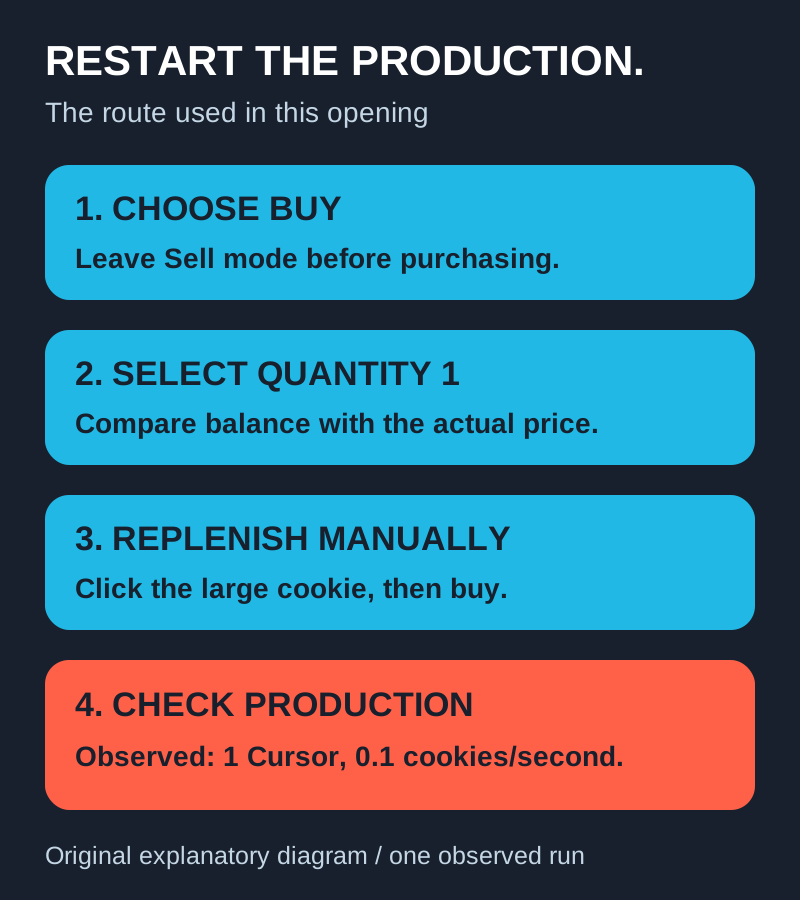
- Choose Buy, then quantity 1. We returned to those controls rather than clicking another building while Sell remained selected.
- Compare balance with the displayed Cursor price. Our 5-cookie balance was below the new 15-cookie price. Clicking the entry at that point did not restore a Cursor or production.
- Click the large cookie to replenish the balance. In this opening, the production readout was zero after the sale, so we used manual clicks instead of relying on the sold machine.
- Buy the Cursor and verify the result. After the purchase was accepted, the store again showed one owned and 0.1 cookies per second. The next Cursor price returned to 18.
If your production is still positive because you own other buildings, this exact zero-production state does not match your run. Compare your own counters before following the same recovery route. We did not test other building combinations or recovery from a later-game sale.
Why this does not establish an exact refund percentage
The store displayed a Sell quote of 4. The later total balance displayed 5. Those values are not interchangeable: the Cursor had been running before the sale, and our reads were neither simultaneous nor a fractional balance audit. We therefore do not subtract the rounded balances, divide 4 by 15, or claim a universal refund percentage. The actionable result is narrower: after this sale, the opening could not immediately repurchase its only producer.
Is selling always a mistake?
No such conclusion follows from one opening. A player's account of expecting a full refund describes why the distinction can surprise beginners. In a separate discussion, players describe later-game reasons to sell buildings, including combinations involving Godzamok and wizard towers. We have not tested those systems here, so their strategies are not instructions for this fresh run.
If you are comparing the best incremental games for your preferred play style, this is a concrete example of a decision that changes the action you must take next: removing the only producer brought manual clicking back. It is not a reason to rank the whole game, nor an optimal purchase-order claim. See the first-Grandma check for a different observed change in early automation.