Best incremental games with a price dial: what moves when you change it?
In our early Universal Paperclips browser run, lowering the displayed price from $0.27 to $0.22 went with a displayed Public Demand rise from 29% to 36%. Raising the price reversed that direction. This is a test of the visible price and demand indicators—not proof that either price earns more money. If you want an incremental game whose first decisions involve a market dial, this is a concrete opening to try.
- Game
- Linked Universal Paperclips browser version
- Observed
- One session's price and demand readouts
- Not measured
- Sales rate, profit or optimal price
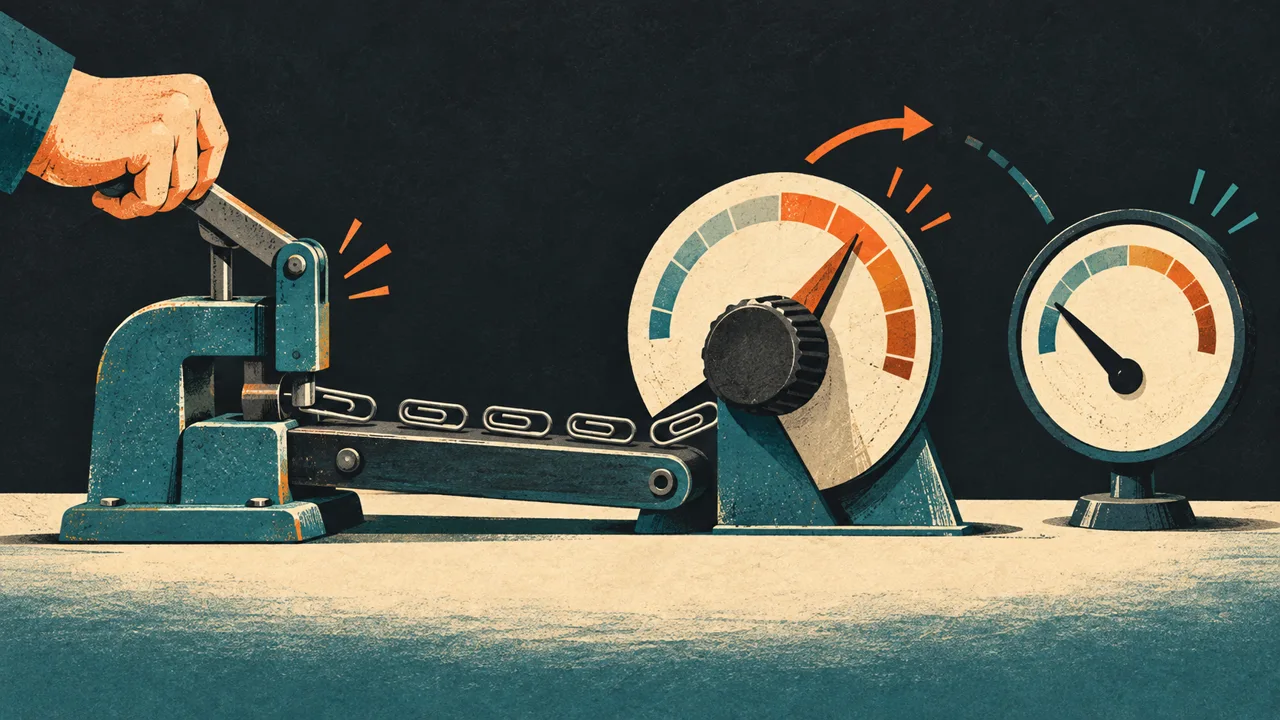
Method: on October 2, 2026, we used the linked game in desktop Chrome. One clip had already been made and sold in this browser state; the page showed $0.24 available funds and zero unsold inventory when this price test began. We pressed the game's lower and raise controls and read its visible Price per Clip and Public Demand fields after each change. We did not buy marketing, add wire, or produce another clip during the price sequence. These are one-session observations, not a calibrated demand formula.
The price-step readout
The same opening panel displayed both Price per Clip and Public Demand. We moved the price down through the lower steps, then back up with raise. The table records a visible reading at each price, not an average across players or a sales experiment.
| Price per clip | Public demand |
|---|---|
| $0.22 | 36% |
| $0.23 | 34% |
| $0.24 | 33% |
| $0.25 | 32% |
| $0.26 | 30% |
| $0.27 | 29% |
Two details matter. At $0.25, the display returned to 32% when we lowered from $0.26; at $0.24 it returned to 33%. The control was reversible in this short run. The percentage did not change by an identical number of points on every one-cent move, so these six rows should not be extended into a made-up linear formula.
Demand is not a receipt
Price is what the panel offers per clip; Public Demand is a separate displayed indicator. With zero unsold clips during our price-only sequence, the available-funds display stayed at $0.24. Moving the price dial alone did not create a new paperclip or a new sale in that state. The game's Make Paperclip control is separate from its lower and raise controls.
A player described getting stuck while repeatedly tweaking price and marketing before focusing on the next unlock. That is one player's account, not a rule for your run. Our narrower test establishes only how the two visible pricing fields responded; it does not settle which setting maximizes income after production or marketing changes.
How to run your own opening check
- Open the linked browser game and note its current price, demand, unsold inventory and available funds.
- Press raise once. Read the new price and demand before doing anything else.
- Press lower to return to the earlier price. Check whether the earlier demand display returns.
- If you want to compare actual income, first create inventory, then separately observe funds and unsold inventory over time at each price. Do not treat the demand percentage alone as a sales count.
This complements our keyboard-control test: that report checked whether the first buttons could be reached and activated; this one checks the visible values after using the pricing controls.
What this test does not rank
We did not measure transactions over equal time windows, balance production against sales, test marketing upgrades, or try later game stages. A higher demand display at a lower price does not by itself establish higher revenue, and a higher clip price does not by itself establish higher profit. This page does not rank Universal Paperclips against every other incremental game; it documents one distinctive early decision for readers who enjoy experimenting with visible cause and effect.